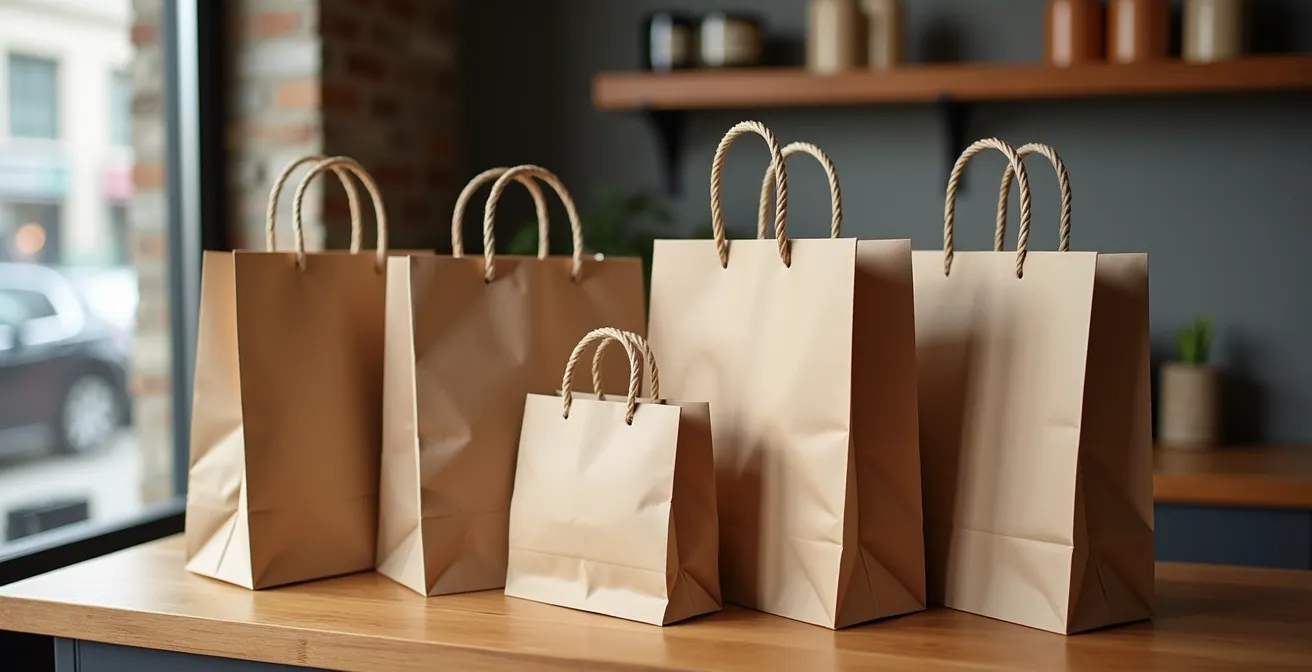
The strength of your kraft paper bag depends not only on the weight of the paper, but on a combination of technical details: handles, bottom, ink type, and design.
- Choose handles (flat or twisted) adapted to the weight of the items and your customer’s journey.
- Systematically integrate a cardboard bottom for heavy or fragile products such as wine or preserves.
- Opt for inks and designs that resist the humidity of the Quebec climate to protect your brand image.
Recommendation: Audit every touchpoint of your future bag to transform this legal constraint into a sustainable competitive advantage and a customer satisfaction tool.
For any retailer in Montreal and across Quebec, the green transition is no longer an option. With the widespread ban on plastic shopping bags, the kraft paper bag has emerged as the obvious alternative. However, this transition raises a legitimate and very pragmatic concern: how can you ensure these new bags won’t break, ruining the customer’s shopping experience and, by extension, your reputation? Many suppliers will talk to you about weight and thickness, but that is an incomplete view of the problem.
The true robustness of a paper bag lies not just in the density of its fiber, but in a holistic approach to its design. It is a delicate balance between several often-overlooked factors: the type of handle, the presence of a reinforced bottom, the impact of ink on the paper’s structure, and even the standardization of sizes to optimize logistics. Ignoring these details risks replacing an environmental problem with a customer satisfaction problem.
What if the key wasn’t searching for the thickest paper, but designing the smartest bag? A bag designed for your reality as a Quebec retailer, for your products, for your customers’ journey, and for the unpredictability of our climate. This article will guide you through the essential technical aspects to make your kraft paper bag not a constraint, but a true asset: a reliable container, an effective marketing medium, and a silent ambassador of your business’s quality.
To support you in this strategic process, this article is structured to address each potential point of failure for your bag and provide concrete solutions adapted to the Quebec context. Explore the table of contents to navigate through these essential tips.
Summary: Mastering the Transition to Reliable and High-Performance Paper Bags
- Twisted or flat handles: which offers the best comfort for a walking customer?
- Why adding a cardboard bottom is essential for wine or candle shops?
- How to adapt your logo colors so they stand out on a natural brown background?
- The mistake of saturating the bag with dark ink that stains clothes in the rain
- When to choose standardized bag sizes to simplify your backstore?
- How to choose an eco-friendly paper that doesn’t compromise the whiteness of your images?
- Why the reusable bag is the cheapest billboard in terms of cost-per-view?
- Why the folding box is the ideal solution to optimize your in-store storage space?
Twisted or flat handles: which offers the best comfort for a walking customer?
The choice of handles is the first point of physical contact between your customer and the bag. Their perception of quality and strength begins here. The dilemma between flat and twisted handles is not just aesthetic; it is functional and must be dictated by the average weight of your items and the typical shopping journey. Flat handles, glued to the inside, are economical and sufficient for light items (clothing, accessories). They offer a wide grip but can become uncomfortable over a long distance if the bag is heavy.
Conversely, twisted handles, which are more robust and often reinforced with a paper patch, are designed to support more significant weight. They are ideal for shops where purchases are heavier or for customers likely to walk for a long time, for example, on a commercial artery like Sainte-Catherine Street in Montreal. As highlighted by the Quebec supplier Nova Envirocom, the design of these two models ensures great rigidity while preserving the fully compostable nature of the bag. For high-end boutiques, die-cut handles can even offer a superior aesthetic alternative, provided the paper weight is sufficient to prevent tearing.
Your action plan for choosing the right handles:
- Analyze the typical customer journey: evaluate whether your customers are walking long distances outdoors or a short distance from a mall parking lot.
- Evaluate the average weight of purchases: inventory your best-selling products to determine the maximum load the bag must support.
- Align with positioning: die-cut handles can reinforce a high-end image, while flat handles are sufficient for a local convenience store.
- Check reinforcements: systematically demand an internal reinforcement patch at the handle glue point, regardless of the model chosen.
- Test resistance: order samples and test them in real conditions, especially against Quebec’s winter humidity, before launching full production.
Ultimately, the best handle is the one that goes unnoticed, fulfilling its function reliably until your customer reaches their destination.
Why adding a cardboard bottom is essential for wine or candle shops?
If handles represent the first test of strength, the bottom of the bag is the guarantor of its structural integrity. For any business selling heavy, concentrated, or fragile items—such as a wine shop, a delicatessen with glass preserves, or an artisan selling heavy candles—the absence of a cardboard bottom is a critical error. This simple addition transforms a flexible bag into a stable base, distributing weight evenly and preventing the sagging that often precedes a tear.
The cardboard bottom prevents cylindrical objects or those with sharp angles from creating tension points on the paper. This ensures that your bottles stay upright and that the corners of a box won’t pierce the bag. The experience of the SAQ, although now oriented toward reusable bags, forged unparalleled expertise in the safe transport of bottles in Quebec. Their early transition highlighted the vital importance of a rigid base, a principle that remains entirely relevant for paper bags intended for similar products.
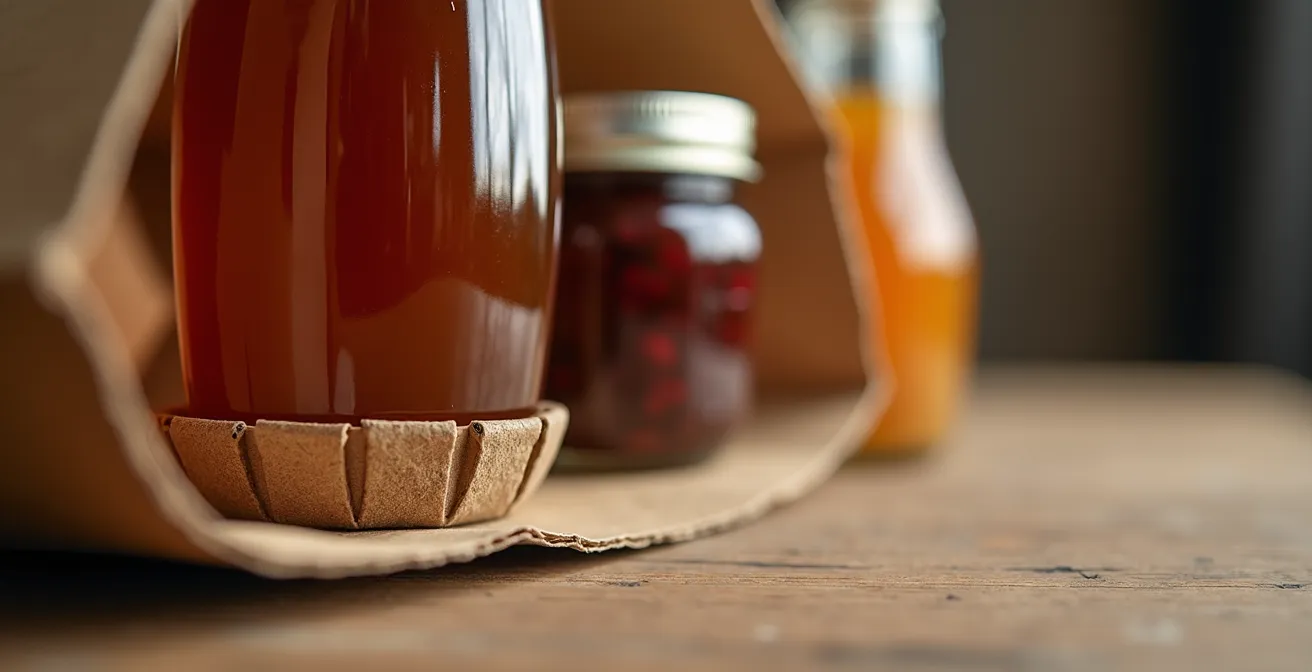
As this image demonstrates, the cardboard bottom creates a stable platform that secures the contents. For a retailer, this is inexpensive insurance against the loss of merchandise and, more importantly, against the frustration of a customer seeing their purchases damaged. It is a non-negotiable detail to guarantee trust.
Investing in a cardboard bottom is therefore an investment in your customers’ peace of mind and the protection of your products until their final destination.
How to adapt your logo colors so they stand out on a natural brown background?
Your bag is a mobile marketing tool. However, a logo with dull or unreadable colors on a brown kraft paper background completely misses the mark. Natural kraft paper, through its shade and texture, tends to “drink” light and desaturate inks. Colors that look vibrant on a screen or white paper can appear dull and lifeless once printed. Adapting your visual identity is therefore a crucial step in preserving your visual brand equity.
Several strategies exist. The most effective is applying a white ink undercoat beneath your logo before printing the colors. This opaque base blocks the color of the paper and allows your original shades to maintain their brilliance. Another option is choosing bleached or tinted kraft paper. Quebec suppliers like Groupe Frontenac generally offer 3 main types of kraft paper (brown, bleached, tinted), giving you more flexibility. Finally, for a more authentic “terroir” look, you can opt for a monochrome (black or white) version of your logo, which creates a strong and elegant contrast. This approach is often more economical and avoids unpleasant surprises.
To ensure the best result, follow these few steps:
- Always order test samples from your local printer.
- Discuss the option of a white undercoat to preserve color brilliance.
- Consider a monochrome version of your logo for maximum contrast and an authentic look.
- Prioritize very bright or very dark colors that better resist kraft paper absorption.
Do not let the natural shade of the paper compromise years of work on your brand image. Proper adaptation is the key to a bag that represents you proudly.
The mistake of saturating the bag with dark ink that stains clothes in the rain
A bag that tears is a problem. A bag that stains a customer’s clothes with bleeding ink is a disaster for your brand image. This is a particularly common error when designs include large areas of solid dark colors. Given Quebec’s climate, with its sudden downpours and melting snow, ink’s resistance to moisture is not an option; it is an absolute necessity. Most standard inks, if not protected, can smudge upon contact with water, creating a catastrophic customer experience.
The solution lies in the choice of materials and printing techniques. An in-depth study conducted by Recyc-Québec on the life cycle of shopping bags emphasizes the importance of environmental and climatic considerations. It is crucial to demand water-based or soy-based inks from your printer, which are less harmful, and to systematically pair them with an aqueous protective varnish. This transparent and eco-friendly varnish seals the ink and makes it water-resistant, preventing any risk of bleeding.
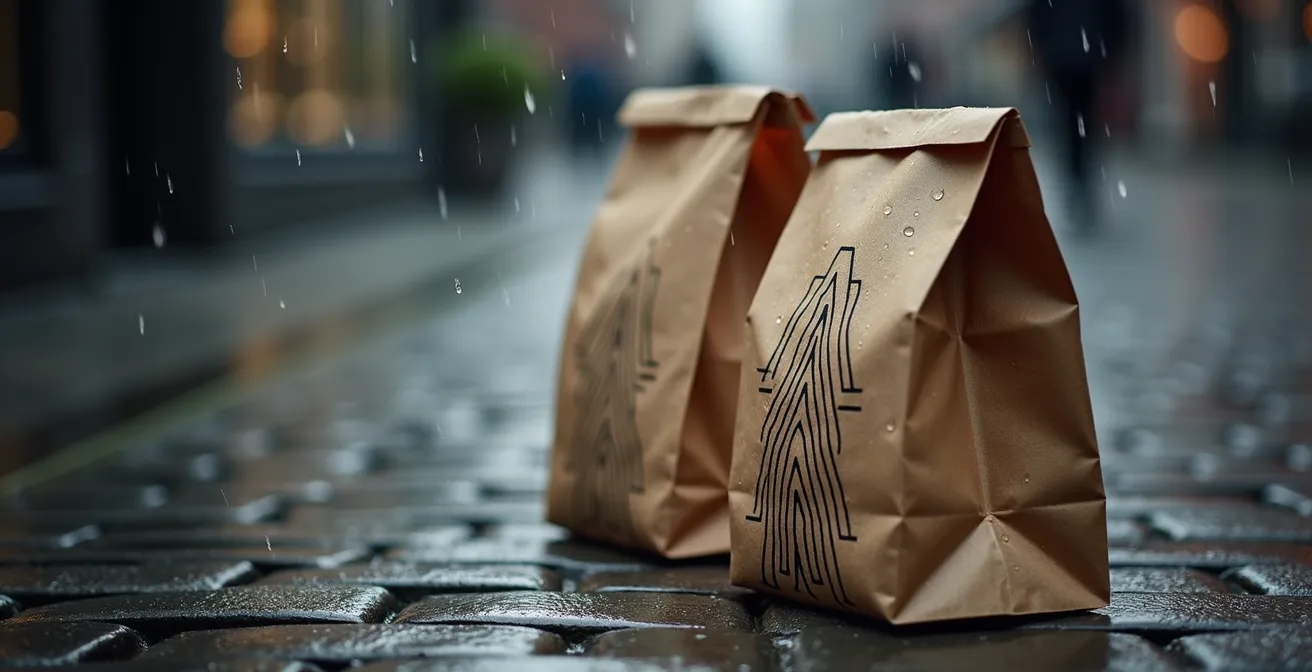
Another complementary approach is to review the design itself. Favor light graphic patterns or a “reverse” logo (where the logo is formed by the natural color of the paper, surrounded by ink) rather than large blocks of color. This minimizes the amount of ink used and therefore the potential risks, while often offering a more elegant result.
By anticipating the worst-case weather scenario, you ensure that your bag, and thus your brand, leaves a positive impression, no matter the weather.
When to choose standardized bag sizes to simplify your backstore?
Managing packaging inventory can quickly become a headache, especially in the often-cramped storage spaces of retail businesses. Offering a unique bag size for every product is a logistical nightmare. Standardization—choosing a limited number of versatile bag formats—is a key strategy to optimize your backstore, reduce costs, and simplify your employees’ daily tasks.
The ideal number of sizes depends on the diversity of your offering. A small artisan boutique in Old Quebec might manage with two or three formats, while a large store like La Maison Simons will need a more extensive range. The goal is to apply an 80/20 logic: identify the 2-3 formats that will cover 80% of your sales. This approach allows for ordering in larger volumes for these sizes, which can generateup to 80% savings on unit costs depending on volumes. It is also a major advantage for omnichannel businesses, which can use the same stock of bags for both in-store sales and online orders.
The following table, inspired by Quebec supplier offerings, illustrates how to adapt your size strategy to your type of business:
| Business Type | Recommended Number of Sizes | Main Advantage |
|---|---|---|
| Small artisan boutique (Old Quebec) | 2-3 standard sizes | Optimization of limited storage space |
| Department store (La Maison Simons) | 5-7 varied sizes | Adaptation to an extensive product range |
| Seasonal/Pop-up shop | 2 versatile sizes | Flexibility for peak activity |
| Omnichannel boutique | 3 standard sizes | Same stock for online and in-store sales |
By simplifying your bag management, you free up space, time, and financial resources that you can reinvest into your core business.
How to choose an eco-friendly paper that doesn’t compromise the whiteness of your images?
For many businesses, particularly in fashion or cosmetics, a white background is indispensable for brand colors and images to be fully expressed. The fear is often that choosing eco-friendly paper implies a compromise on whiteness and print quality. Fortunately, today it is entirely possible to reconcile environmental responsibility with impeccable visual rendering.
The key is to look beyond the simple “recycled” label. Bleached kraft is an excellent option. Look for eco-friendly bleaching processes like TCF (Totally Chlorine Free), which uses no chlorine, or ECF (Elemental Chlorine Free), which uses far less polluting chlorine derivatives. Additionally, it is essential to look at the recycled content, specifically PCW (Post-Consumer Waste), which indicates the portion of paper originating from consumer recycling. Papers containing a high percentage of PCW can offer excellent whiteness. Some manufacturers even offer bags made with up to 70% recycled paper, reaching very high whiteness standards.
To make an informed choice in Quebec, here is a practical approach:
- Check recognized certifications like FSC (Forest Stewardship Council) or SFI (Sustainable Forestry Initiative), which guarantee sustainable forest management.
- Ask your supplier about the exact percentage of PCW recycled content.
- Explore the ranges of Quebec papermakers recognized for their ecological commitment, such as Rolland or Cascades.
- Always demand printed samples on the final paper before validating your order to judge the whiteness and color rendering for yourself.
By choosing the right paper, you send a dual positive message to your customers: you care about the planet without ever compromising the quality of your brand image.
Why the reusable bag is the cheapest billboard in terms of cost-per-view?
While the discussion often centers on the single-use paper bag, one must not forget its big brother: the reusable bag. In the post-plastic ban context in Montreal, every citizen walking with a reusable bag becomes a brand ambassador. An analysis of the impact of Montreal legislation revealed that this ban has paradoxically increased the marketing value of reusable bags, transforming them into real “walking billboards” that are much more visible than before.
The calculation is simple. A high-quality reusable bag, used dozens or even hundreds of times, exposes your logo on the street, on public transit, and at other retailers. The initial cost of the bag, divided by the number of views, makes it one of the most cost-effective advertising mediums available. The example of the SAQ is striking: by switching exclusively to reusable bags, it not only helped eliminate nearly 80 million disposable bags per year, but also placed its logo in the hands of millions of Quebecers on a recurring basis. Adoption can be massive, as confirmed by Johanne Riverin of Recyc-Québec regarding a similar initiative:
The average person wasn’t making the shift. 700,000 bags were sold in a very short period of time.
– Johanne Riverin, Recyc-Québec
Offering a high-quality, robust, and aesthetic reusable bag is not just an ecological gesture; it is a long-term marketing strategy. It is offering your customers a useful object they will be proud to carry, spreading your brand well beyond the walls of your shop.
Rather than simply enduring the transition, you can transform it into a powerful opportunity for visibility and loyalty.
Key Takeaways
- The strength of a kraft paper bag relies on its reinforcement points (handles, bottom) and not on paper weight alone.
- Printing on kraft must be anticipated: prioritize high contrasts, white undercoats, or inks and varnishes adapted to the Quebec climate.
- Standardizing bag sizes and considering folding solutions like boxes drastically optimizes storage space and backstore costs.
Why the folding box is the ideal solution to optimize your in-store storage space?
Beyond the bag, the gift or packaging box is another central element of the customer experience. Here too, backstore logistics is a major issue. Traditional rigid boxes, delivered pre-assembled, are elegant but extremely bulky. For a business with limited storage space, they represent a real burden. This is where the folding box, delivered flat, becomes a revolutionary logistical solution.
The main advantage is the drastic reduction in storage volume. As shown in the comparative table below, the space required to store folding boxes is up to 10 times less than that required for rigid boxes. This solution is particularly relevant for seasonal businesses, which are very popular in Quebec, such as Christmas markets or summer boutiques. A supplier like EDR Packaging emphasizes that this flexibility allows for managing peak activity without tying up precious space for the rest of the year—a crucial advantage for small shops on Saint-Jean Street in Quebec City or in the Plateau Mont-Royal.
| Criterion | Assembled Rigid Boxes | Flat Folding Boxes |
|---|---|---|
| Storage volume (500 units) | 15-20 m³ | 1-2 m³ |
| Omnichannel adaptability | Limited | Excellent (store + e-commerce) |
| Ideal for | Large spaces, constant volume | Small boutiques, seasonal businesses |
| Assembly time | 0 seconds | 5-10 seconds (automatic assembly available) |
Although requiring a quick assembly (often just a few seconds), the folding box offers unmatched flexibility and perfectly adapts to an omnichannel strategy, where the same flat packaging can be easily stored for both online and in-store sales.
By adopting smart packaging solutions like the folding box, you don’t just save space; you make your entire operation more agile and more profitable. To put all these tips into practice, the next step is to audit your current or future suppliers using this analysis grid to demand solutions that guarantee strength, aesthetics, and logistical efficiency.