
The modern business card is no longer a simple piece of cardstock, but a strategic interaction trigger that connects the physical to the digital.
- NFC technology integration creates an instant, memorable experience that sets you apart.
- Interaction tracking, strictly regulated by Law 25 in Quebec, transforms networking into business intelligence.
Recommendation: Think of your card not as an expense, but as an investment in your first “phygital” touchpoint, designed to initiate a lasting conversation.
Imagine the scene, familiar to any professional in Montreal or Quebec City: the end of a networking event, pockets filled with a miscellaneous collection of business cards. A week later, this pile of cardstock often ends up forgotten at the back of a drawer, or worse, in the trash. For decades, the business card was a miniature CV, a simple information carrier. Advice for “modernizing” it was often limited to choosing thicker paper or opting for a minimalist design.
These elements are important, but they miss the essence of the current transformation. The real challenge is no longer how your card is *perceived*, but what it *does*. The question is no longer “is it pretty?”, but “does it trigger an action?”. We are entering the era of the business card as a “phygital bridge”: a physical object whose sole mission is to create a seamless, memorable, and measurable digital connection. It is a tool that no longer just provides your contact details, but actively invites your interlocutor into your digital ecosystem.
This article is not just a gallery of design trends. It is a strategic guide to rethinking your business card as a true performance tool. We will explore how NFC technology can create a “wow” effect, how data tracking can become your best sales ally while strictly complying with Quebec’s Law 25, and how well-chosen finishes influence your contact’s psychology long before you’ve said a word.
To effectively navigate through these concepts, this guide is structured to take you from the psychological foundations of the first impression to the most advanced technological applications. The summary below will give you a clear overview of the journey we will take together.
Summary: Transforming your business card into an intelligent networking tool
- Why does the quality of your business card determine 80% of the first impression?
- How do high-end finishes influence the perception of your business documents?
- Why does an NFC chip in your paper card impress instantly?
- How to link your card to your LinkedIn profile and track who scans it?
- Frosted or transparent plastic cards: what impact for an architect or designer?
- The mistake of using a QR code that is too small for old phones to scan
- When to add neon color to the edge so your card stands out from the pile?
- How to equip your sales team with printed tools that close deals?
Why does the quality of your business card determine 80% of the first impression?
Before even addressing technology, it is essential to understand a fundamental psychological principle: the halo effect. When a person forms a positive first opinion based on a single characteristic, they tend to generalize that impression to all other facets of that person or their company. Your business card is often that first tangible characteristic. A card that looks cheap, with paper that is too thin or subpar printing, doesn’t just communicate a lack of budget; it subconsciously installs the idea that your work, services, or products might also lack rigour and quality.
The perception of quality is multisensory. The paper weight (gsm) is the first signal: a heavy, rigid card is associated with substance and reliability. The surface texture (smooth, linen, velvet) creates a tactile experience that can reinforce brand positioning: luxury, natural, innovation. It is non-verbal communication that speaks volumes about the care you put into details. By handing over your card, you are not just transmitting information; you are transferring physical proof of your professionalism.
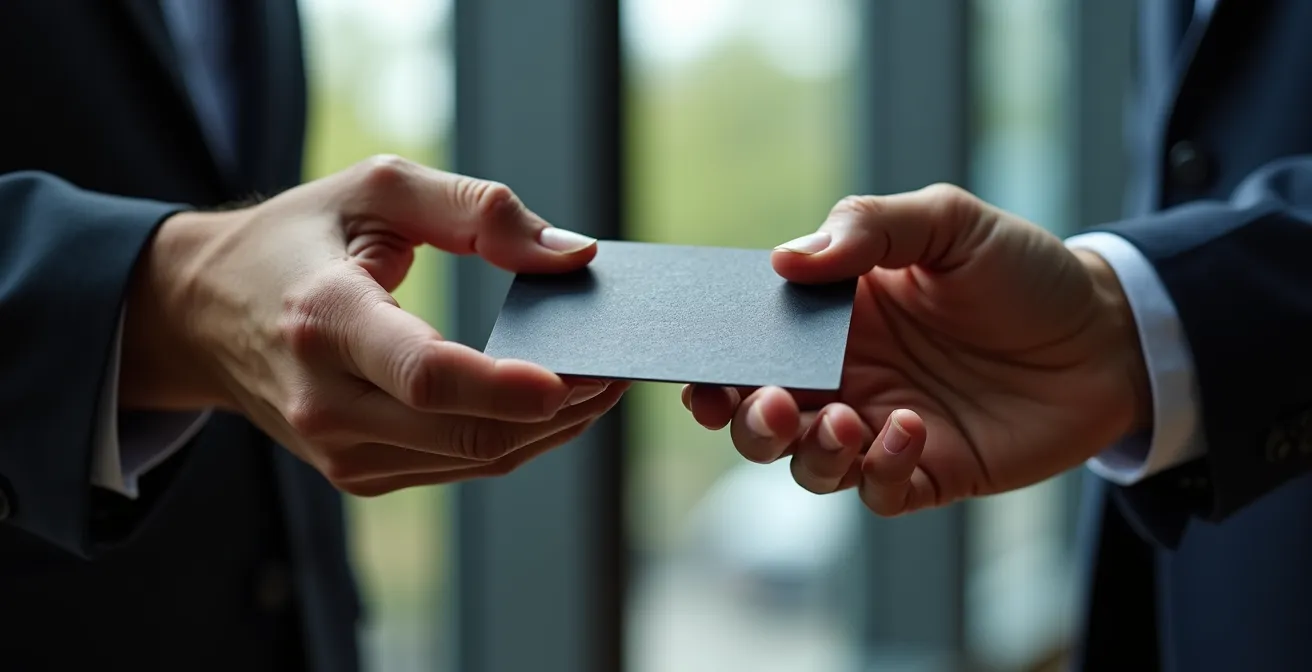
This exchange is a ritual. As the image shows, the moment the card passes from one hand to another is a crucial touchpoint. Ignoring the quality of this object is like showing up to an important job interview with unpolished shoes. It suggests a negligence that can sabotage trust before the conversation even truly begins. Investing in a quality card is therefore not a luxury; it is the first step in building likability and credibility capital.
How do high-end finishes influence the perception of your business documents?
If paper quality is the foundation, finishes are the architectural elements that catch the eye and create a visual hierarchy. They transform a simple card into a miniature work of art and subtly reinforce your message. Each finish has a specific psychological function that can be aligned with your brand image.
Spot UV is an excellent example. By applying a glossy layer to a specific area of a matte-finished card, you create tactile and visual contrast. The eye and finger are immediately drawn to the highlighted element, whether it’s your logo or a pattern. It’s an elegant way of saying: “Look here, this is important.” For a tech company, it might evoke a screen interface. For a luxury brand, the sparkle of a jewel.
Embossing (raised relief) and debossing (recessed relief) play with the physical dimension. They invite the recipient to touch and explore the card. An embossed logo isn’t just seen; it is felt. This tactile interaction creates a deeper, more memorable connection than a simple flat print. It communicates craftsmanship, solidity, and an almost sculptural attention to detail. This is a particularly powerful choice for professions where material and construction are central, such as architecture, interior design, or fashion.
Finally, hot foil stamping (gold, silver, copper) never goes out of style because it taps into powerful archetypes of value and prestige. Used sparingly, it confers immediate premium status. It doesn’t scream; it whispers exclusivity. Choosing the right finish is not simply about decorating; it’s about adding a layer of silent but extremely eloquent communication to your primary brand ambassador.
Why does an NFC chip in your paper card impress instantly?
Beyond the tactile, the true revolution is the integration of technology directly into the paper. An NFC (Near Field Communication) chip transforms your business card from a passive object into a magical interaction trigger. The gesture is strikingly simple: your contact brings their phone close to your card, and an action is instantly triggered on their screen. This could be opening your website, adding your details to their contacts, or displaying your LinkedIn profile.
This technology is no longer a niche gadget. One projection estimates that the global NFC business card market will reach USD 50.01 million by 2030, reflecting growing adoption. The “wow” effect is guaranteed because the experience is smooth, frictionless, and perceived as cutting-edge. You don’t just say you are innovative; you demonstrate it in a fraction of a second. This moment creates a positive break in the classic card exchange ritual and anchors a memorable impression.
Local Case Study: TapInc, Quebec Efficiency
A company like Quebec-based TapInc perfectly illustrates this trend. They offer customizable NFC cards that not only modernize networking but also address environmental concerns by reducing paper waste. During professional events in Quebec, a simple “tap” allows for instant information sharing, making every meeting more efficient and memorable.
Unlike a QR code which requires opening the camera and aiming, NFC is almost instantaneous on most modern phones. This fluidity is crucial: it eliminates any potential barriers and transforms information sharing into an enjoyable and surprising experience. An NFC card is no longer just a piece of cardstock; it is a remote control for your digital universe.
How to link your card to your LinkedIn profile and track who scans it?
The advantage of a connected card doesn’t end with the “wow” effect. Its true power lies in its ability to collect data for precision networking. By linking your QR code or NFC chip to a tracked redirect URL (via services like Bitly or digital business card platforms), you can know how many times your card has been scanned. However, in Quebec, this data collection is strictly regulated.
In fact, since September 2023, Law 25 on the protection of personal information requires obtaining manifest, free, and enlightened consent for any collection of information that allows a person to be identified. This means you can track the number of scans anonymously, but if you want to know *who* scanned your card (for example, by asking for an email before providing access to a document), you must obtain their explicit agreement. This is the principle of “compliance by design”: the user experience must integrate the request for consent transparently.

This legal constraint is actually an opportunity. It forces you to create an honest value exchange. Instead of simply “tracking,” you offer something useful (a white paper, a demo, a direct link to your Calendly) in exchange for contact information. The analytical dashboard then becomes a powerful commercial management tool, showing you which events are the most productive or which messages work best.
The following table clarifies what is possible to do while respecting Quebec legislation.
| Feature | Without Consent | With Law 25 Consent |
|---|---|---|
| Number of scans | ✓ Authorized | ✓ Authorized |
| Geolocation | ✗ Prohibited | ✓ Possible |
| User Identification | ✗ Prohibited | ✓ Possible |
| Export to CRM | ✗ Prohibited | ✓ Possible |
Frosted or transparent plastic cards: what impact for an architect or designer?
For creative and technical professions such as architecture, graphic design, or UX/UI design, the card’s material is a direct extension of their art. Plastic, whether transparent or frosted, offers conceptual possibilities that paper cannot match. It is no longer just about perceived quality, but a true statement of creative intent.
A transparent plastic card is a powerful medium for playing with notions of layering, structure, and void. An architect can print the outlines of a building on it, inviting the interlocutor to see “through” the structure. A UX designer can draw the wireframes of an application, with the transparency of the plastic mimicking that of a screen. This material communicates clarity, modernity, and a conceptual approach where nothing is hidden. It is the embodiment of structured and visionary thinking.
Frosted (or acid-etched) plastic offers a softer, more subtle alternative. Its translucency evokes mystery, the diffusion of light, and a certain sophistication. It is less direct than transparent plastic and suggests a depth that reveals itself gradually. For a lighting designer, it can mimic the effect of a diffuser. For a photographer, it can recall soft focus. The touch is also unique, often silky, adding a dimension of refinement to the object.
Choosing between these materials is not trivial. It is a decision that must reflect the creative’s philosophy. Transparency for rigour and structure, frosted for subtlety and atmosphere. In both cases, the card becomes more than a simple information carrier: it becomes a miniature portfolio piece, a tangible taste of the professional’s aesthetic and intelligence.
The mistake of using a QR code that is too small for old phones to scan
The QR code has become a staple of the modern business card, a simple bridge between paper and digital. However, its effectiveness is often sabotaged by a fundamental design error: a code that is too small, poorly contrasted, or lacks a protective margin. The result is a frustrating user experience. Your contact pulls out their phone, tries to scan once, twice, three times… and gives up. The hoped-for “wow” effect turns into a moment of friction that damages your image.
The cause is often a misunderstanding of technical constraints. Sensors on older phones or entry-level models need a larger, more contrasted code to read it correctly, especially in low-light conditions (like in a restaurant or during an evening event). Thinking that “it seems to work” on the latest iPhone is a serious error in judgment. A business card must be universally functional.
To ensure your phygital bridge doesn’t collapse on the first try, it is imperative to follow precise technical rules. This ensures a smooth experience for 100% of your interlocutors, not just those who own the latest technology. Accessibility is a mark of professionalism.
Technical Checklist for a Foolproof QR Code
- Minimum size: Ensure the code measures at least 2 x 2 cm to be easily scannable from a distance of 10 cm.
- High contrast: Aim for at least 70% contrast between the code and the background. Black on white remains the absolute ideal for maximum readability.
- Quiet zone: You must leave a white margin (or solid background color) all around the code, equivalent to the width of 4 small squares (modules) of the code itself.
- Error correction: Configure your QR code with a high error correction level (Level H, 30%). This allows it to be read even if it is slightly damaged or scratched.
- Multi-device testing: Don’t just test on your own phone. Try it on an iPhone 6 and an Android model from 2018 or older to guarantee maximum compatibility.
When to add neon color to the edge so your card stands out from the pile?
In a world saturated with visual information, standing out is a challenge. Painted edges (“edge painting”) is a subtle but incredibly effective finishing technique. It involves applying a color, often bright or neon, to the thickness of the card. Its true genius is revealed not when the card is alone, but when it ends up where most cards do: in a pile on a desk.
Imagine this pile of white cards. In the middle, a streak of bright color irresistibly catches the eye. This is what’s known as a “pattern interrupt”, a break in an expected visual pattern that commands attention. Your card no longer blends in; it becomes a landmark, a beacon. This is a considerable psychological advantage. When your contact looks for “the card of that interesting person I met yesterday,” chances are their visual memory will be hooked on this unique detail.

This technique is particularly relevant for brands that want to communicate energy, creativity, boldness, and modernity. A communication agency, a design studio, a tech startup, or any professional wishing to project a dynamic and non-conventional image. Choosing a neon color (pink, green, orange) is a bold statement, while a more sober but contrasting color (an electric blue, a deep red) can connote a more institutional modernity. For the effect to be successful, it is essential to use very thick paper (600gsm or more), as a thin edge will not offer enough surface area for the color to have a strong visual impact.
Key Takeaways
- Your business card is not a document, but a phygital bridge designed to trigger a digital action.
- Technology (NFC, QR code) must primarily create a smooth and memorable user experience, without any friction.
- In Quebec, any data tracking strategy via your card must be thought out in advance to be fully compliant with Law 25.
How to equip your sales team with printed tools that close deals?
Ultimately, a business card for a sales professional is not just a networking tool; it is an instrument for conversion. By combining the technologies and finishes we have explored, you can equip your sales teams with true “deal triggers.” Each card can be personalized to maximize each salesperson’s effectiveness.
Imagine a salesperson at a trade show. Instead of handing out a generic card, they provide a personalized NFC card. With one “tap,” the prospect has not only the salesperson’s contact details but also a direct link to their Calendly schedule to book an appointment, a product demo video, or a form to request a quote. Integration with a CRM (like HubSpot or Zoho) can even automatically create a new lead entry, attribute the contact source to the event, and trigger a follow-up email sequence. Manual work is eliminated, the risk of forgetting is zero, and the sales cycle is considerably accelerated.
This level of automation and tracking is extremely powerful, but it must be done in compliance with Quebec’s legal framework. Non-compliance with Law 25’s consent rules is not an option, as penalties can be dissuasive, ranging up to $25 million or 4% of global turnover. Transparency is therefore not only ethical; it is economically vital. A well-designed card will request consent clearly in exchange for obvious added value for the prospect.
By providing your salespeople with these smart cards, you aren’t just giving them a way to leave their contact info. You are giving them a tool to qualify leads, initiate sales actions, and measure the performance of their networking efforts in real-time. The business card ceases to be a cost and becomes a profit center.
To transform your networking into concrete results, the next step is to audit your current tools and define a custom “interaction trigger” strategy aligned with your brand and business objectives.