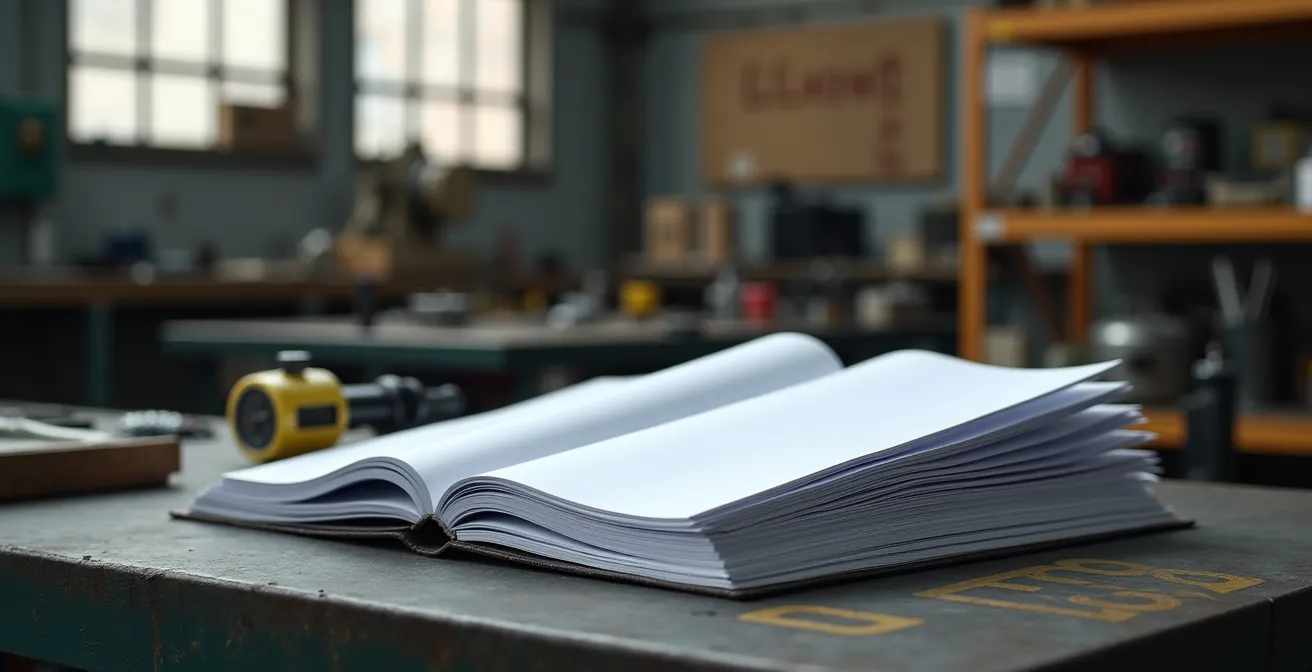
Contrary to popular belief, the printed catalog is not an outdated tool for Quebec B2B; it is a high-performance work instrument, optimized for productivity in demanding environments.
- Its physical structure offers superior cognitive ergonomics compared to a digital interface for searching for complex parts.
- Its resilience (no battery, no Wi-Fi) makes it an indispensable, trusted tool in Quebec’s factories and workshops.
Recommendation: Do not just digitize your catalog; design it as a strategic work tool where every detail, from the binding to the index, serves to accelerate the industrial buyer’s decision.
For a sales manager in the Quebec manufacturing sector, the scene is familiar. A buyer, hands covered in grease in a workshop in Val-d’Or, needs to identify a critical part. Is their first reflex to pull out a phone, remove their gloves, and navigate a slow website? Or to turn to the sturdy catalog sitting on the workbench, the one they can leaf through quickly to find the exact reference in less than 30 seconds? In the majority of cases, the answer still leans heavily toward paper.
Many companies, pushed by the “all-digital” wave, have neglected this tool, viewing it as a costly relic. They invest heavily in complex online platforms, forgetting a fundamental reality: their customers’ work environment. The debate is not “paper versus digital.” It is time to move beyond this sterile opposition and understand the true nature of the industrial catalog. It is not a mere sales medium, but an optimized work tool—an instrument of formidable efficiency whose physical design directly addresses the buyer’s productivity constraints.
What if the real key to B2B industrial commercial performance wasn’t replacing paper, but mastering its cognitive ergonomics? The catalog is not a passive object; it is an interface. Its tangibility, structure, and reliability make it a pillar of the trust capital between a supplier and its client. A well-designed catalog is a promise of seriousness and efficiency, a physical anchor in an increasingly volatile supply chain.
This article will deconstruct the mechanics of this reference tool. We will analyze how every element, from the index to the binding, contributes to its performance. We will see how to structure it not as a simple product list, but as a guided path leading to the sale, and how to intelligently integrate it into a modern phygital strategy designed for the Quebec market.
To effectively navigate the strategies that make the printed catalog an indispensable sales tool, this summary details the essential points we will cover. Each section is designed to provide you with concrete action levers adapted to the reality of the Quebec B2B market.
Summary: Making Your B2B Industrial Catalog More Effective
- Why a cross-index (name/reference) is vital for saving your customers time
- How die-cut tabs facilitate navigation in a 500-page catalog
- Case binding or spiral: which survives best in a greasy mechanical workshop?
- The fatal error of printing volatile prices (and why to use a separate price list)
- When to integrate QR codes to video technical sheets to lighten the paper load?
- How to structure your commercial brochure to guide the prospect toward signing?
- How to produce a printed annual report that reassures your investors and partners?
- How to succeed in your flyer campaign in the Publisac or by mail despite the decline of paper?
Why a cross-index (name/reference) is vital for saving your customers time
The index is not the end of your catalog; it is its main entrance. In the urgency of a workshop or on a construction site, a buyer does not “browse.” They are looking for a precise solution, and fast. The effectiveness of your catalog is measured by the number of seconds required to go from the need to the information. A high-performance index is therefore a silent but powerful sales argument. It demonstrates that you understand and respect your customer’s time. Forgetting this tool, or designing it poorly, is a major source of frustration that can push a loyal customer toward a competitor whose catalog is better thought out.
The key is the double entry, or cross-index. Your customer does not always think like your engineering department. They might look for a product by its common name (“a shear pin”), by its internal reference (SKU: SHP-075-B), or even by its application (“part for John Deere harvester model X”). An index that only offers one of these paths is a dead end for two-thirds of your users. A cross-index, which lists products by alphabetical name AND by numerical reference, cuts search time in half and eliminates friction.
The organization of this index must follow a logical hierarchy. Structuring products by major families, then by sub-families, helps the buyer contextualize their search even if they don’t know the exact name. This is the principle of cognitive ergonomics: the human brain navigates more easily through a logical tree structure than through a raw list. This transforms a tedious search into a guided and intuitive discovery.
Case Study: The Effectiveness of SCN Industrial’s K37 Catalog in Quebec
The K37 catalog from distributor SCN Industrial is a leading example for the Quebec market. With over 500 pages of products, its ease of use is crucial. They implemented a sophisticated numbering system where “A” pages can be inserted by distributors for their own products, while “B” pages constitute the standard catalog. This flexibility, combined with a rigorous index, allows buyers to navigate a colossal volume of information without getting lost, demonstrating how a well-thought-out structure transforms a simple book into a true productivity tool in the field.
Ultimately, the index is a reflection of your corporate culture: are you focused on your products or on your customers’ productivity? A well-made index is a promise kept—the promise to never waste the time of those who trust you.
How die-cut tabs facilitate navigation in a 500-page catalog
If the index is the map, die-cut tabs are the highways of your catalog. For a work exceeding several hundred pages, relying solely on the index or sequential flipping is an unacceptable waste of time for a professional. Tabs offer direct and physical access to key sections. With a simple glance at the edge, the user spots their destination, grabs the corresponding tab, and instantly accesses the right product family. This kinesthetic interaction is infinitely faster and more intuitive than clicking through several menu levels on a digital interface.
The effectiveness of tabs rests on their ability to materialize the catalog’s structure. They transform an abstract data tree into tangible landmarks. To maximize their utility, it is crucial to limit them to the 5 to 7 most important product categories. An excess of tabs recreates the visual “noise” of an overloaded menu and negates their benefit. The choice of sections to highlight is therefore a strategic act that must reflect your customers’ most frequent purchase paths.
For an industrial catalog destined for the Quebec market, robustness is non-negotiable. Tabs must be reinforced, often with lamination, to withstand repeated handling with gloved or dirty hands. Adding a distinct color code for each tab further strengthens visual memorization and accelerates navigation, allowing a seasoned user to find their section without even reading the text.

This comparative table, inspired by best practices in interface design, highlights the strengths and weaknesses of different navigation systems for a large physical catalog. It becomes clear that die-cut tabs offer the best compromise between direct access and clarity for most industrial uses.
| System | Advantages | Limitations | Ideal For |
|---|---|---|---|
| Die-cut tabs | Direct access, immediate visual identification | Maximum 5-7 main sections | Catalogs up to 500 pages |
| Alphabetical index | Search by precise name | Requires knowledge of terminology | Experienced professionals |
| Color coding | Intuitive navigation by category | Limit of 8 distinct colors | Segmentation by customer industry |
| Reinforced dividers | Durability in difficult environments | Additional production cost | Intensive workshop use |
In short, tabs are proof that the design of a physical object can surpass a digital interface in terms of speed and ergonomics, provided it is thought out for its final context of use: action, not contemplation.
Case binding or spiral: which survives best in a greasy mechanical workshop?
The choice of binding is not a technical detail; it is a strategic decision that determines the lifespan and utility of your catalog in the field. A catalog whose pages fall out after three weeks of intensive use in a workshop in Beauce is a lost investment and a degraded brand image. The central question is: should the tool be able to open flat, or should it primarily resist the worst conditions?
Spiral binding (or Wire-O) has a major advantage: it allows for a 360-degree opening. The catalog can be laid flat on a workbench without closing, or be folded back on itself, taking up less space. This is an undeniable asset for consultation. However, its weakness lies in the spirals themselves. Made of metal or plastic, they can deform under impact, get snagged, and the perforations can weaken the paper, leading to torn pages in an environment where delicacy is not common.
In contrast, case binding (or “perfect binding” with Smyth sewing) is the champion of durability. This is the method used for hardcover books. The page signatures are sewn together before being glued to a robust cover. This technique offers incomparable strength. The spine is protected, the pages are secure, and the catalog can withstand years of abuse. Its main drawback is that it doesn’t open perfectly flat, especially at the beginning and end of the book, which can make consulting near the binding slightly less comfortable.
For a greasy mechanical workshop, durability often takes precedence over comfort. A sewn case binding, combined with thicker paper and a protective varnish on the pages, represents the best defense against wear, tears, and stains. Furthermore, integrating an eco-responsible approach is an increasingly strong argument in Quebec. Using certified papers is a positive signal. Indeed, according to the Quebec procurement portal, it is possible to opt for high-quality papers, as even for government tenders, it is stipulated that 100% of the papers offered contain 50% to 100% post-consumer fiber, proving that durability and responsibility can go hand in hand.
Ultimately, a case binding is often the rational choice for reference catalogs intended to last several years, while the spiral can be reserved for training manuals or more ephemeral price lists.
The fatal error of printing volatile prices (and why to use a separate price list)
Printing prices directly in your main catalog is one of the costliest mistakes you can make. In today’s economy, where raw material and transport costs fluctuate unpredictably, a printed price becomes obsolete in a few months, or even weeks. A catalog with incorrect prices creates immense frustration for your customers and a colossal administrative workload for your sales team, who must constantly correct, justify, and renegotiate. This undermines trust and turns your beautiful sales tool into a source of disputes.
Volatility is not an exception but the new norm, particularly for an open economy like Quebec’s. A significant part of the economy relies on products whose prices are dictated by global markets. For example, an analysis by the Quebec Ministry of Economy, Innovation, and Energy reveals that nearly 54% of the value of Quebec exports is concentrated in just 25 products, demonstrating high sensitivity to market fluctuations. Anchoring your prices in the stone of a catalog printed for 2 or 3 years is therefore an economically perilous strategy.
Once printed, changing your references or prices can become more complicated.
– B2B Catalog Expert, Kimayo Guide for B2B Catalogs
The strategic solution is to separate the reference catalog from the price list. Your main catalog, designed to last 2 to 3 years, becomes a stable technical and descriptive tool. It contains photos, diagrams, technical specifications, applications… but no prices. Concurrently, you produce a separate price list on a lighter, less expensive medium (a simple booklet or inserts). This list can be updated quarterly or semi-annually at a fraction of the cost of reprinting the full catalog. A tip is to integrate a robust transparent pocket inside the cover of your main catalog to slide in the current price list. It’s simple, effective, and professional.
By adopting this method, you preserve the long-term value of your main catalog as a reference tool while maintaining the agility needed to adapt to a market in constant motion. You offer your customers reliable technical information and always up-to-date pricing—the best of both worlds.
When to integrate QR codes to video technical sheets to lighten the paper load?
The printed catalog and digital are not enemies; they can form a powerful alliance. The QR code is the simplest and most effective bridge to connect these two universes. However, its integration is not a gimmick. It must meet a specific need: when the static information of paper reaches its limits, the QR code takes over to offer a richer and more dynamic experience without weighing down the catalog with superfluous pages.
The ideal time to integrate a QR code is when a visual demonstration or very dense information is necessary. For example, for a complex piece of equipment, a QR code placed next to the product can link to:
- A demonstration video showing the machine in action.
- A step-by-step installation or maintenance tutorial.
- A complete technical sheet of 10 pages in PDF format.
- An interactive 3D view of the product.
The mistake to avoid is overloading the catalog with useless QR codes. Each code must have clear added value. A QR code that simply links to your website’s home page is a waste of time. The link must lead directly to the promised content, without intermediate steps. You must also consider the context of use: if your customer is in an area without reliable cellular network (a reality in some industrial or rural regions of Quebec), the QR code will be useless. The paper content must therefore always be self-sufficient for essential information (identification, dimensions, compatibility).
The phygital approach via QR code also allows for tracking engagement. By using unique URLs for each code, you can measure which products generate the most digital curiosity and interest, providing you with valuable data to optimize your future editions and your online content strategy. It’s an intelligent way to make your paper tool talk.
In summary, the QR code is not there to replace paper, but to augment it. It is the tool that allows you to keep the tangible power of the catalog while grafting onto it the infinite richness of the digital world, in a targeted and intelligent way.
How to structure your commercial brochure to guide the prospect toward signing?
If the catalog is the technical encyclopedia, the commercial brochure is the persuasive narrative. Its goal is not to be exhaustive, but to build a logical and emotional argument that guides the prospect from point A (awareness of a need) to point B (conviction that you are the solution). An effective brochure is not a mere collection of features; it is a printed sales funnel. Every page, every section must move the reader forward in their decision journey.
The narrative structure is therefore paramount. For a Quebec prospect, sensitive to local buying and trust-based relationships, the following structure is particularly effective:
- The Cover (The Promise): It must captivate with a benefit-oriented headline, your logo, and strong local trust markers like the “Well Made Here” logo or BNQ (Bureau de normalisation du Québec) certifications.
- About Us (The Trust): Forget the corporate speak. Show faces. Present your team, your local factory, your history in Quebec. Humanize your company to create an emotional connection.
- Your Problem (The Empathy): Before talking about your solutions, talk about your customer’s challenges. Show that you perfectly understand their issues and “pain points.”
- Our Solution (The Logic): Present your products or services not by their features, but by the benefits they provide in response to the problems mentioned. Use clear diagrams and visuals.
- Social Proof (The Validation): This is where you anchor your credibility. Include testimonials from recognized Quebec clients, along with their logos and impactful quotes. A data-driven case study is even more powerful.
- Call to Action (The Next Step): Never leave the prospect in the dark. Clearly indicate what they should do next: “Schedule a demo,” “Request your personalized quote,” with direct and local contact information (a 1-888 number is less personal than a local Drummondville number).

This structure transforms the brochure from a simple informative document into a true “silent salesperson.” It anticipates the prospect’s questions, removes objections, and naturally leads them toward making contact. Print quality, paper choice, and finishing (spot UV, embossing) are not luxuries, but elements that reinforce the message of professionalism and quality of your company.
Ultimately, a successful brochure does more than inform; it persuades. It tells a story where your customer is the hero, and your company is the guide that helps them succeed.
How to produce a printed annual report that reassures your investors and partners?
The printed annual report, far from being a simple legal obligation, is a major strategic communication tool, particularly in the Quebec B2B environment where business relationships are often built over the long term. In an era of ephemeral news and volatile digital communication, receiving a physical and polished annual report is a strong signal. It is a gesture that signifies stability, transparency, and respect toward your partners and investors. It materializes the solidity and seriousness of your company.
To be reassuring, an annual report must go beyond simply presenting figures. It must tell the story of the past year, highlight successes, explain challenges with honesty, and, above all, outline a clear vision for the future. It is an exercise in storytelling based on facts. The narrative must be positive but realistic. Contextualizing the company’s performance within the local economic environment is crucial for credibility. For example, mentioning that results were achieved in a context where, according to the Institut de la statistique du Québec, a 2.5% increase in wages and salaries was observed in the third quarter of 2024, demonstrates sound management and a contribution to the local economy.
Design and print quality play a fundamental psychological role. Quality paper, a professional and airy layout, clear infographics to present complex data, and high-quality photographs of your teams and projects are all elements that translate into the financial health and future confidence of your organization. A report that seems rushed or made on a shoestring budget will send the exact opposite message, regardless of the quality of your financial results.
The structure must be designed for different reading levels. An executive summary (the “President’s Message”) for those in a hurry, clear sections for financial results, CSR (Corporate Social Responsibility) strategy, innovations, and future perspectives. Using call-out boxes to highlight key figures or striking quotes helps guide the reader and reinforce main messages.
Ultimately, the printed annual report is your annual trust audit. It is the opportunity to reaffirm your solidity, celebrate your collective successes, and strengthen ties with those who support your growth. It is an investment in your reputation that pays off long after it is read.
Key Takeaways
- The printed catalog is not obsolete; it is a performance tool optimized for productivity in industrial environments.
- The key to success lies in its ergonomics: cross-indexes, reinforced tabs, and appropriate binding are strategic, not aesthetic, choices.
- Separating the technical catalog (long lifespan) from the price list (volatile) is an economic necessity to preserve trust and profitability.
How to succeed in your flyer campaign in the Publisac or by mail despite the decline of paper?
Claiming that paper is in decline is a simplification. What is in decline is non-targeted mass marketing. The flyer, whether via the Publisac or direct mail, can still be a formidably effective tool in B2B, provided it is approached with the precision of a scalpel rather than the force of a hammer. The challenge is no longer to spray everyone, but to reach the right person, with the right message, at the right time.
The first step is intelligent geographic and demographic targeting. Instead of city-wide distribution, focus on specific industrial zones, technology parks, or even streets where your prospects are concentrated. Demographic data can also refine your strategy. For example, MAPAQ data indicates that the average age of the Quebec population is rising, and that the share of visible minorities reached 18% of the active population in 2021. Although this data concerns the general population, it serves as a reminder not to rely on outdated archetypes and to adapt the message and visuals to a diverse audience, even in B2B.
The second key is measurability. A flyer without a tracking mechanism is a cry in the wilderness. Systematically integrate an element that allows you to measure Return on Investment (ROI):
- A unique promotional code for an online order.
- A physical coupon to present for a consultation or discount.
- A QR code leading to a specific landing page to download a white paper or request a demo.
Your Action Plan for a Targeted B2B Flyer Campaign
- Touchpoints: List the geographic zones (industrial parks, potential client addresses) and channels (Canada Post, Publisac) for your campaign.
- Collection: Inventory your current offers. What is the most irresistible offer for a new B2B prospect (e.g., free audit, discount on first order)?
- Consistency: Ensure the flyer’s message is perfectly aligned with your brand positioning and the “pain points” of your target.
- Memorability/Emotion: Is the design generic or does it stand out? Use quality paper and strong visuals to avoid the recycling bin.
- Integration Plan: Define your tracking mechanism (promo code, QR code, coupon) and prepare your sales teams to handle the responses.
In conclusion, the flyer is not dead, but its use has changed. By treating it as a precision direct marketing tool—paying close attention to targeting, messaging, and measurement—it remains a powerful acquisition lever for reaching B2B prospects who may be less solicited through this channel than they are by email.